
EXPERTS IN THYROID SURGERY AND NON-SURGICAL PRECISE™ THYROID ABLATION.
Auckland Thyroid Centre is dedicated to all things relating to the thyroid. Staffed by a small team of highly trained professionals, we provide a complete care service for the thyroid and related issues. We are Auckland's expert provider of a wide range of surgical and non-surgical thyroid care.
Founded by Dr. Francis Hall, head surgeon, and a New Zealand pioneer of non-surgical procedures, including Thyroid Radiofrequency Ablation and Thyroid Ethanol Ablation. Francis created Auckland Thyroid Centre to give Auckland a clinic focused on all forms of thyroid surgery, treatments, and care, for the thousands of women (and men!) facing thyroid problems every year.
A small but vital gland, central to your body's growth, metabolism, and the healthy function of your heart, brain, and beyond.
The thyroid is a butterfly-shaped gland which lies low in the front of your neck, near the windpipe (trachea). It consists of two halves (lobes), each about the size of a cherry tomato, connected by a small bridge of tissue called the isthmus.
The thyroid produces two important hormones: thyroxine (T4) and a smaller amount of triiodothyronine (T3). Thyroid hormones are essential for growth, development, and metabolism, and are involved in the optimal functioning of essential organs such as the heart and brain.
The amount of T4 and T3 produced in your body is controlled by another hormone: Thyroid Stimulating Hormone (TSH). A simple blood test can measure the levels of T4 and TSH in your body, and allows doctors like Dr. Hall to determine whether your thyroid is functioning properly.
Iodine in the bloodstream is actively taken up by thyroid cells through an area on the cell surface called a symport, a process controlled by TSH. Once inside the thyroid cell, iodine undergoes several chemical processes and is combined with thyroglobulin (a protein made in the thyroid gland) to make thyroid hormones, which are then released under the control of TSH.
Thyroxine (T4) and triiodothyronine (T3) are essential for growth, metabolism, and the healthy function of your heart and brain.
Thyroid Stimulating Hormone regulates how much T3 and T4 your thyroid produces. A simple blood test checks your levels.
Thyroid cells actively absorb iodine from the bloodstream and combine it with thyroglobulin to produce thyroid hormones.
When thyroid conditions cannot be managed with medication or non-surgical treatment, surgery may be the right path forward.
A thyroidectomy is a surgical procedure to remove your thyroid gland. Depending on your condition, either half (hemithyroidectomy) or all (total thyroidectomy) of your thyroid is removed. If the entire thyroid is removed, you will need to take daily thyroid hormone (thyroxine) replacement medication following the surgery, usually a tablet or two of thyroxine every day half an hour before breakfast.
Thyroid surgery is done under general anaesthesia (GA) to ensure your comfort. The recurrent laryngeal nerve is monitored throughout the operation. If a total or completion thyroidectomy is performed, a blood test to check the calcium and PTH levels, is done later the same day and the following morning. Most patients undergoing thyroid surgery will stay overnight in hospital and take one to two weeks to recover. Most patients do not find the post-surgery recovery particularly painful but may find it uncomfortable.
An incision is placed in a skin crease on the neck, resulting in a less-visible scar. Usually, after a while, the scar is difficult to see.
Dr. Francis Hall has performed hundreds of thyroid operations and takes the utmost care to avoid injury to surrounding neck structures during surgery. However, all surgery carries some risk. Complications are very uncommon (about 1-2%).
To find out more about thyroid conditions and thyroidectomy, click this link to Dr Francis Hall's website.
Visit Dr Francis Hall's Website →From first investigation through to advanced ablation, Auckland Thyroid Centre covers the full thyroid pathway.
No Scalpels. No Sutures. No Scars.™
Expert targeting of thyroid lumps, treating only the lump and leaving otherwise healthy tissue undamaged.
Share a few details and our team will be in touch to understand your situation. Whether you're at the start of your thyroid journey or looking for a second opinion, we're here to help.
A minimally invasive, outpatient procedure that shrinks thyroid nodules using a targeted probe without surgery, general anaesthetic, or scarring.
Radiofrequency Ablation uses a fine needle electrode, guided by ultrasound, to deliver controlled radiofrequency energy directly into a thyroid nodule. The heat destroys the target unhealthy tissue while preserving surrounding healthy thyroid function.
Most patients return to normal activity within 24 to 48 hours, and don't require thyroid hormone replacement because the rest of the gland remains untouched.
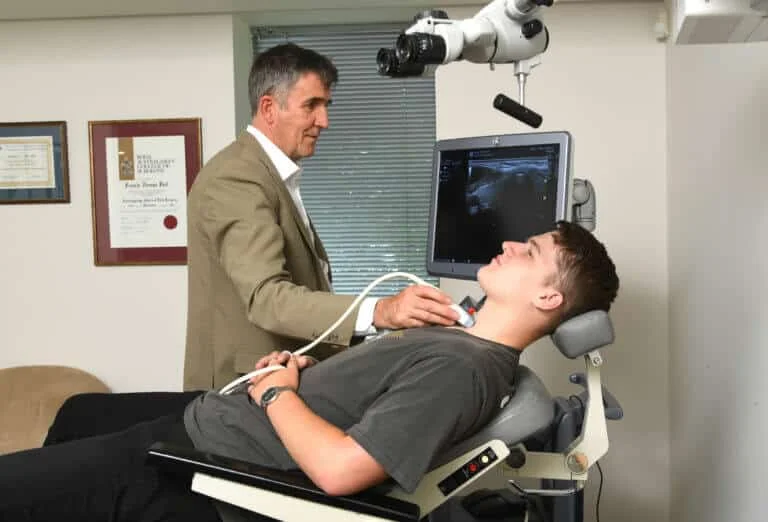
In many cases, for benign thyroid nodules, RFA offers dramatically less disruption than a thyroidectomy.
Not every nodule is suitable for RFA. A consult with Dr. Hall will confirm the best path for you.
A straightforward pathway from first consult to same-day treatment.
Review your ultrasound, blood results, and symptoms with Dr. Francis Hall to confirm whether RFA is the right option for you.
Fine Needle Aspiration (FNA) or Core Needle Biopsy if needed, to confirm the nodule is benign before treatment.
Ultrasound-guided ablation under local anaesthetic. Typically 30 to 60 minutes. You rest briefly, then go home.
Check-ins at 3, 6, and 12 months to measure nodule shrinkage and ensure lasting results.
A complete library of 23 short, clear videos covering everything from how the thyroid works through to surgical and non-surgical treatment options. Watch the featured highlights below or explore the full collection on YouTube.
Covering thyroid conditions, treatments, surgery options, and patient care.
Meet Dr Francis Hall and learn about his approach to thyroid care and treatment.
Discover the common symptoms associated with thyroid disorders.
Learn what recovery after thyroid surgery may involve for most patients.
An overview of Dr Hall's experience in ENT, head and neck, and thyroid surgery.
Understanding how thyroid conditions can affect pregnancy and maternal health.
An overview of the main forms of thyroid cancer and how they differ.
A simple introduction to the thyroid gland and its role in the body.
Learn what patients can expect during a thyroid examination and consultation.
Understanding the different surgical procedures used to treat thyroid conditions.
Learn how the thyroid helps regulate energy, metabolism, and hormone balance.
An overview of the tests commonly used to assess thyroid conditions.
Compare the different surgical and non-surgical thyroid treatment approaches.
An overview of how thyroid hormones are created and used by the body.
A guide to the most frequently diagnosed thyroid diseases and conditions.
Learn how Radiofrequency Ablation offers a non-surgical option for thyroid nodules.
Understand why thyroid health plays such an important role in overall wellbeing.
An overview of the treatment options available for thyroid conditions.
An overview of Ethanol Ablation and how it may help treat thyroid cysts and nodules.
An overview of common thyroid conditions and related health concerns.
Learn about medications commonly used to manage thyroid disorders.
Learn how molecular testing can help guide thyroid diagnosis and treatment planning.
Learn who may be more likely to develop thyroid conditions.
Addressing common questions and concerns patients may have before surgery.
Subscribe for new videos and updates
Dr. Francis Hall's website has additional patient resources, published medical articles and a wide variety of information on thyroid health, conditions and treatments. Have a read, then come back here to book your consultation.
Dr. Francis Hall leads Auckland Thyroid Centre with a full range of thyroid procedures and surgeries as well as a specialist focus on minimally invasive, non-surgical thyroid treatments.
With deep expertise in ultrasound-guided ablation techniques, Dr. Hall has helped Auckland patients avoid surgery for benign thyroid nodules where surgery isn't necessary.
Auckland Thyroid Centre brings specialist thyroid care together under one roof, from testing and diagnostics through to the most advanced surgical and non-surgical treatments available in New Zealand.
RFA is performed under local anaesthetic. Most patients describe the experience as a sensation of pressure or warmth rather than pain, and discomfort afterwards is usually mild and manageable with paracetamol.
Most RFA procedures take between 30 and 60 minutes. You'll be observed briefly afterwards and usually head home the same day.
Because RFA only targets the nodule, leaving the rest of the thyroid untouched, most patients do not require lifelong hormone replacement. This is one of the main advantages over surgery.
The treated nodule continues to shrink over 6 to 12 months. Most patients notice symptom relief (pressure, visible lump, swallowing issues) within the first few months.
Some insurers cover RFA under minimally invasive thyroid procedures. Our team can help you understand coverage and provide the paperwork your insurer needs.
RFA is most effective for benign, symptomatic thyroid nodules. A consultation with Dr. Francis Hall will review your ultrasound, bloods, and symptoms to confirm whether you're a good candidate.
Book a consultation with Dr. Francis Hall and find out which option is right for you.